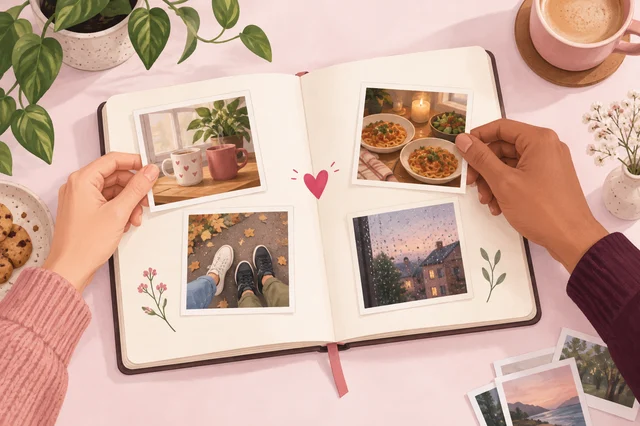
When you want to ask your partner something beyond ‘How was your day?’, start with one small detail: what made them smile, what they noticed, or what they’d like to do together. Answer the question yourself, too, and let one follow-up grow out of what they say. You don’t need a long list or an unusually interesting day—just something you’re both happy to share.
For new couples, this can be a gentle way to explore the little things: the snack they always choose, the song they replay, the kind of evening they enjoy. Try the ideas below as invitations, not a test of how well you know each other.
What can you ask instead of ‘How was your day?’
Try: ‘What’s one little thing from today you’d like to show me?’ Then share your own answer. A photo is optional; describing something is enough.
Here’s a made-up exchange you can borrow:
You: ‘What’s one little thing from today you’d like to show me? Mine is this lopsided sandwich. I tried to make a proper lunch and everything fell out.’
Your partner: ‘The dog I passed on my walk. It was carrying a stick twice its size.’
You: ‘Excellent priorities. If we had a free afternoon, would you pick a long walk or a very long lunch?’
Your partner: ‘Walk first, lunch after. What about you?’
That’s a complete activity: one moment each, one question, and a little room to wander. It can happen on the sofa, over a call, or in messages. There’s no need to turn every answer into a deep conversation. Sometimes learning that you both put lunch at the centre of a good afternoon is plenty.
What are some light questions for getting to know your partner?
Choose one that sounds like something you’d actually say. You can change the wording, offer two options, or give your own answer first.
Everyday preferences
- What’s your ideal breakfast when you don’t have to rush?
- Which tiny convenience would you miss most if it disappeared tomorrow?
- Would you rather spend a spare hour outside or somewhere cosy?
- What song belongs on the soundtrack of your week?
- What’s a food you could happily eat two days in a row?
These are starting points, not a compatibility scorecard. If your partner chooses the opposite of what you’d pick, you can simply ask what they like about it. There’s no correct shared answer.
Small memories
- What snack reminds you of being younger?
- Is there a place you’d enjoy showing me one day?
- What’s an ordinary family tradition you still like?
- What did you love doing on a free afternoon as a kid?
- What’s a little thing you kept because of the memory attached to it?
Memory questions can be more personal than they look. Let your partner choose how much to say. ‘I’d rather skip that one’ is an answer you can accept without asking for an explanation.
Things you could try together
- If we made dinner together, what job would you claim?
- What’s a small outing you’d like us to try?
- Would you pick a puzzle, a game, or a film tonight?
- What would make a rainy afternoon at home feel good?
- What’s something you’d enjoy teaching me, even if I’m terrible at it?
If an idea appeals to you both, make it concrete: choose a meal, name a nearby place, or put a film on your list. But a conversation doesn’t have to end in a plan. You can enjoy the answer and leave it there.
How can you turn an ordinary moment into a conversation?
Use a simple pairing: one moment, one question.
Start with something you noticed, then ask a question connected to it. That gives your partner a little context rather than a prompt arriving out of nowhere.
For example:
- A photo of your coffee: ‘I finally found a cup I really like. What’s your favourite slow-morning drink?’
- A quick sketch of the weather: ‘This is my artistic interpretation of today’s rain. What would you want to do if we were home together?’
- A description of your lunch: ‘I tried something new. What’s one food you’d like us to make?’
- A song you heard: ‘This came on while I was walking. What song would you put on for a drive together?’
You don’t have to manufacture a moment for the activity. A window, a plant, your slightly chaotic desk, or something that made you laugh will do. If sharing a picture feels like extra work, a sentence is enough.
In PairStreak, each partner can share a daily photo, video, or doodle. Those daily moments stay hidden until both partners have contributed. Once they’re revealed, you can use what you shared as a starting point for a question in your private chat.
The point isn’t to make an impressive update. It’s to offer a small piece of your day and get curious about theirs—just the two of you.
How do you keep it from feeling like an interview?
Take turns answering the same question instead of moving straight to the next one. If you ask about a favourite childhood snack, share yours as well. You’re part of the conversation, not the host of a quiz show.
Then choose a follow-up from the answer you actually heard.
If your partner says their ideal Sunday involves a bookshop, you could ask, ‘Would you browse for hours or go in for one book?’ You don’t need to jump to an unrelated question about holidays just because it’s next on a list.
Here are a few ways to keep the activity easy:
- Offer a choice: ‘A question, a game, or just a chat tonight?’
- Go first when you want to: ‘Mine would be a late breakfast. What would you choose?’
- Leave space: You don’t have to fill every pause with another prompt.
- Stop naturally: If the conversation moves elsewhere, follow it.
You can also say what you’re hoping for: ‘I’d like to learn a little more about what you enjoy. Want to try one question?’ That makes the invitation clear without expecting a particular answer.
What if your partner gives a short answer?
A short answer doesn’t tell you, by itself, why someone kept it short. Rather than guessing, offer an easy choice: ‘Want to tell me more, or shall we save this for another time?’
If they want to keep talking, ask about one detail. ‘You said the walk was nice—what did you see?’ is a possible follow-up. If they don’t, you can leave it there.
You can make the question smaller, too. ‘Tell me everything you’re looking forward to’ might become ‘Is there one thing you’d like to do this weekend?’ But smaller shouldn’t mean persistent: if they’ve said they don’t want to answer, respect that.
For questions that matter to you beyond this playful activity, choose a time you both agree to talk. A light prompt doesn’t need to carry every important conversation in your relationship.
Can you make it playful without testing each other?
Try guessing an everyday preference, then give your partner the final word.
For example: ‘I think you’d choose a picnic over a restaurant if the weather was good. Am I right?’ Then swap roles. Being wrong can simply be a chance to hear what they’d pick and why.
Keep the guesses low-stakes. Favourite snacks, dream breakfasts, and rainy-day activities are different from guessing someone’s feelings about an important decision. You can ask directly when the subject needs a direct answer.
PairStreak also includes couple games, which you can choose as a different way to spend a little time together. The questions in this article are suggestions you can use yourselves, not a list of prompts promised inside the app.
If a playful exchange turns competitive in a way neither of you enjoys, drop the score—or choose a different activity. The aim here is curiosity, not proof that one person knows the other better.
What can you do with the little things you learn?
Keep what you both want to revisit: a shared photo, a dinner idea, a place to try, or a moment you found funny. Ask before saving or sharing something your partner considers personal.
PairStreak keeps a record of your shared moments, so you can return to the ordinary days you’ve captured together. You might revisit a lunch photo and remember the recipe you wanted to try, or a rainy-day doodle and the evening it led you to plan.
There’s no need to turn this into a record of every answer. Some conversations can just belong to the evening you had them.
Frequently asked questions
What’s a good first question for a new couple?
Try ‘What would your ideal free afternoon look like?’ It leaves room for an everyday answer. Share yours, too, and ask about one detail if you both want to continue.
Do we need to ask a question every day?
No. Use these ideas when they feel welcome. You can share a moment without adding a question, play a game instead, or leave the activity for another day.
Can we do this when we’re apart?
Yes—you can exchange a moment and a question in messages or during a call. You don’t have to answer immediately; agree on a pace that works for both of you.
What if a question feels too personal?
Skip it or choose a lighter one. Neither partner needs to explain a boundary before the other respects it.
Should we work through the whole list?
You don’t need to. Pick one question you like and see where it goes. The list is there for inspiration, not completion.
Start with one little thing
Tonight, try sharing one ordinary moment and asking one question about it. Answer each other, follow what interests you, and stop when you’re ready.
If you’d like a place for those moments, try PairStreak with your partner. Share daily photos, videos, or doodles, talk in your private chat, play couple games, and return to your shared memories. Not another feed—just a place for the two of you.