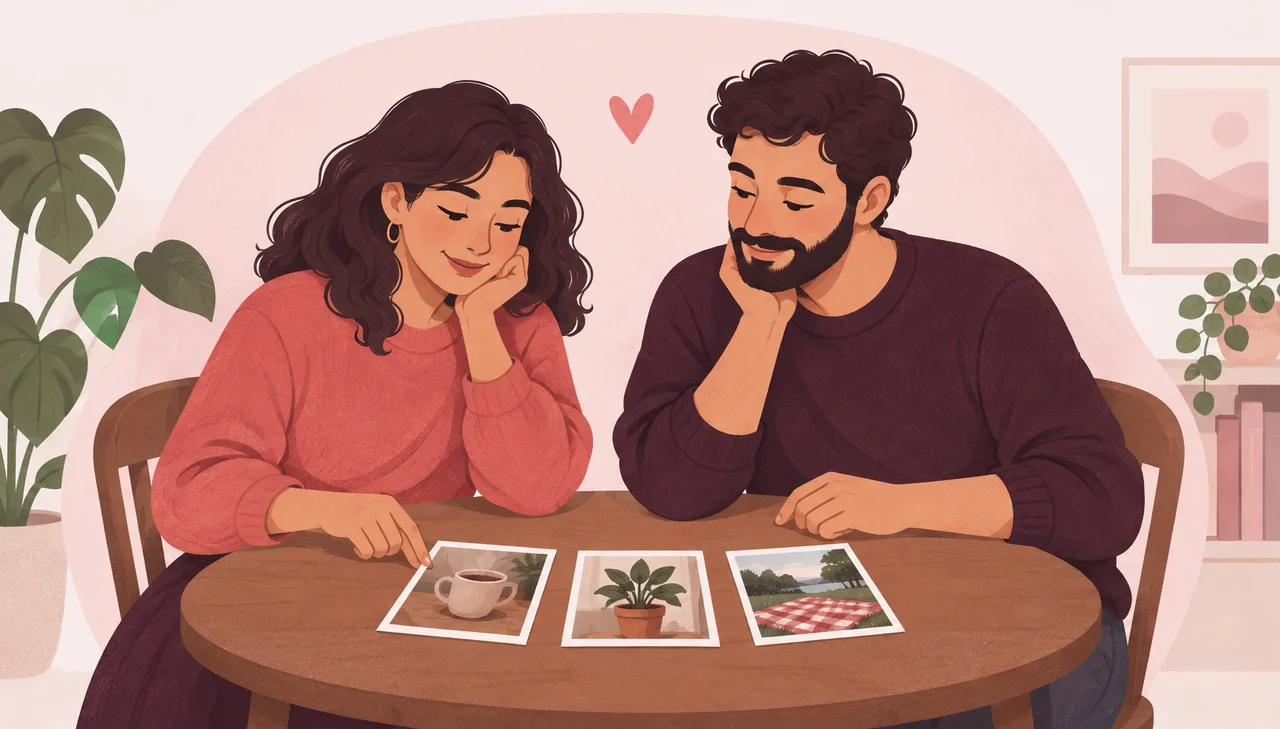
To agree on which couple photos stay private, start with one ordinary picture and ask where each of you is comfortable sharing it. Keeping it between you, sending it to a family group and posting it publicly are different choices. Agree on the audience for that photo, leave room for either person to say no, and ask again before sharing it somewhere new.
You don’t need to sort your whole camera roll tonight. Try a short conversation with a picture you already have. If you’d like somewhere for the moments you choose to exchange privately, PairStreak offers daily photos, videos or doodles, private chat and shared memories—without a public feed.
What could this conversation sound like?
Here’s a made-up example, not a customer story.
You have a photo from dinner at home. One partner is laughing beside a slightly collapsed homemade pizza. You both like the memory, but that doesn’t automatically mean you both want the same audience.
You: “I love this pizza photo. Would you like to keep it just between us, or would you be happy for me to send it to my family group?”
Your partner: “Let’s keep the one with me in it between us. You can send the picture of just the pizza.”
You: “Okay. I’ll use that one for the group and keep this one for us.”
That can be the whole exchange. You’ve chosen a specific photo, named a specific audience and accepted the answer. Nobody needs to defend why they prefer one picture over another.
If you later want to put the pizza-only photo on a public account, ask about that separately. “Fine for your family” wasn’t an answer about every possible place it could go.
How do we start without making it a big project?
Choose a calm moment and one low-stakes photo: breakfast, a walk or something you made together. Don’t begin with a folder of pictures for your partner to approve before you can get on with your evening.
Try this small check:
- Show the exact picture. Make sure you’re discussing the same image, not a general idea of a nice photo.
- Name where you want it to go. “My family group” is clearer than “online” or “to a few people.”
- Ask what feels comfortable. Keeping it private is an available answer, not the disappointing option.
- Listen to both preferences. Each person gets a say about photos involving them and personal details they’ve shared.
- Leave it unshared if you haven’t agreed. You can choose another image or enjoy the moment without posting it.
This is an activity you can try with any photo and the tools you already use. It isn’t a special approval feature inside PairStreak.
What does “private” mean for this particular photo?
Use ordinary words instead of relying on a label you might interpret differently. “Private” could mean keeping a photo on your own phone, sharing it with your partner, or putting it in a small group. Say which one you mean.
For example:
- Just between us: “I’m happy for you to see this, but please don’t send it to anyone else.”
- A named group: “This one is okay for our family chat, but I don’t want it on a public profile.”
- A particular post: “I’m happy with this photo and this caption on that account.”
- Not something to keep: “I’d rather we didn’t save this picture.”
You don’t have to use all these categories. They’re ways to make the conversation concrete, not a system you need to maintain.
Also look beyond faces. A photo of a kitchen table might include a letter, a work screen or something another person didn’t choose to share. You can select a different picture rather than trying to make this one suitable for every audience.
How can we ask without making the answer feel loaded?
Ask before building a post around the photo. “I’ve already written a lovely caption; you don’t mind, do you?” makes a different invitation from “Would you be comfortable with me posting this?”
You could say:
“I like this picture of us. Are you happy for me to share it with my friends, or would you rather it stayed with us?”
Then accept the answer without turning the photo into a discussion of how much your partner cares. A preference about an audience doesn’t need to become a test of affection.
Give your own preference, too. Perhaps you like a silly picture in a private exchange but don’t want it on a public profile. Both of you can enjoy a moment and still choose not to make it available elsewhere.
The question comes up in public reader discussions. One visible Reddit question asks about requesting permission before a boyfriend posts photos on social media. The original post’s body has been deleted, so we aren’t drawing conclusions about that couple or reconstructing what happened. The useful starting point is simply the question: have we agreed before sharing?
What if one of us likes posting and the other doesn’t?
Start with the particular image rather than trying to settle every future post. One person might enjoy sharing a dinner photo; the other might prefer a picture of the plates rather than a candid portrait. You can look for an option both actually want.
That might mean sharing the scenery, choosing another photo together or not posting anything. A changed crop or caption is a suggestion to discuss, not a way to work around a no.
Avoid asking repeatedly in slightly different forms until your partner agrees. If neither of you wants the same option, leave the picture unshared and return to the larger conversation another time if you both want to.
For something lighter to do afterwards, our low-energy activities for couples offer a doodle, a song each or an ordinary-object hunt. You don’t need to create a new photograph from the activity, either. Some evenings can stay unrecorded.
How could PairStreak fit into this?
PairStreak is a private space for two partners. Its website describes shared moments as staying inside your pair, with no public profiles, followers or feed. That gives the small exchange a different setting from a public post.
Begin with your agreement about what you each want to share. Then, if the daily format appeals to both of you:
- Each choose a moment. A photo, video or doodle can be enough. You don’t need to share a portrait or anything you consider personal.
- Contribute your own daily moment. Your partner’s daily moment stays hidden until you’ve shared yours. Both open after both partners have contributed.
- Continue in private chat if you want. You can text, react and send additional photos, videos or doodles.
- Return to shared memories. Revisit the ordinary moments you’ve exchanged, without needing to make them public.
The app isn’t a substitute for asking each other. We’re not describing a photo-permission workflow, screenshot blocking or a guarantee that someone cannot copy or share something outside the app. “Please keep this between us” remains something to say and respect, not a technical promise we’re making here.
If keeping everyday details is what appeals, our shared memory journal guide has a small first entry you can borrow. A private exchange and a public announcement don’t have to be the same thing.
What if we change our minds later?
Leave room to say so. You might have liked a picture last week and feel differently about it today. Ask about the specific change you want: “Could you take that photo off your profile?” or “Please don’t use that one in another post.”
If you’re the person receiving the request, respond to what your partner has asked rather than arguing that they once agreed. Discuss what you can change in the places you control. Don’t promise that removing a post will remove every copy someone else may have kept.
You can also revisit a general preference when your circumstances change. A family update, a new workplace or simply a different comfort level can be a reason to ask again. You don’t need to anticipate every future situation in tonight’s conversation.
Your couple-photo questions
Do we need to ask before every single photo?
Agree together on what feels welcome, and check when you’re unsure. Permission for one image and audience shouldn’t be treated as permission for every future picture. This guide offers a conversation, not legal advice.
What if only one of us is in the picture?
Ask that person before sharing it. Also consider whether the photo includes personal details belonging to someone else. You can choose an ordinary object or a different scene instead.
Does sending a photo privately mean it can go in a group chat?
Don’t assume so. Ask about the group specifically. Being happy to show your partner a moment isn’t the same decision as showing everyone they know.
Do we need an app to try this?
No. Start with a picture you already have and a short conversation. PairStreak is an optional private place for the daily moments you both choose to exchange.
Can we keep some moments without taking photos at all?
Yes. Describe the moment, draw something small or simply enjoy it together. Our questions beyond “How was your day?” offer a conversation you can try without a camera.
Choose one moment and its audience
Pick one ordinary picture. Say where you’d like to share it, ask what your partner wants and leave space for the photo to stay between you. You don’t need a public audience to enjoy something together.
If you’d like a private place for both sides of your day, try PairStreak with your partner. Each bring a photo, video or doodle, reveal your daily moments after both contribute, and continue in your own chat. Start with what you both feel happy sharing.