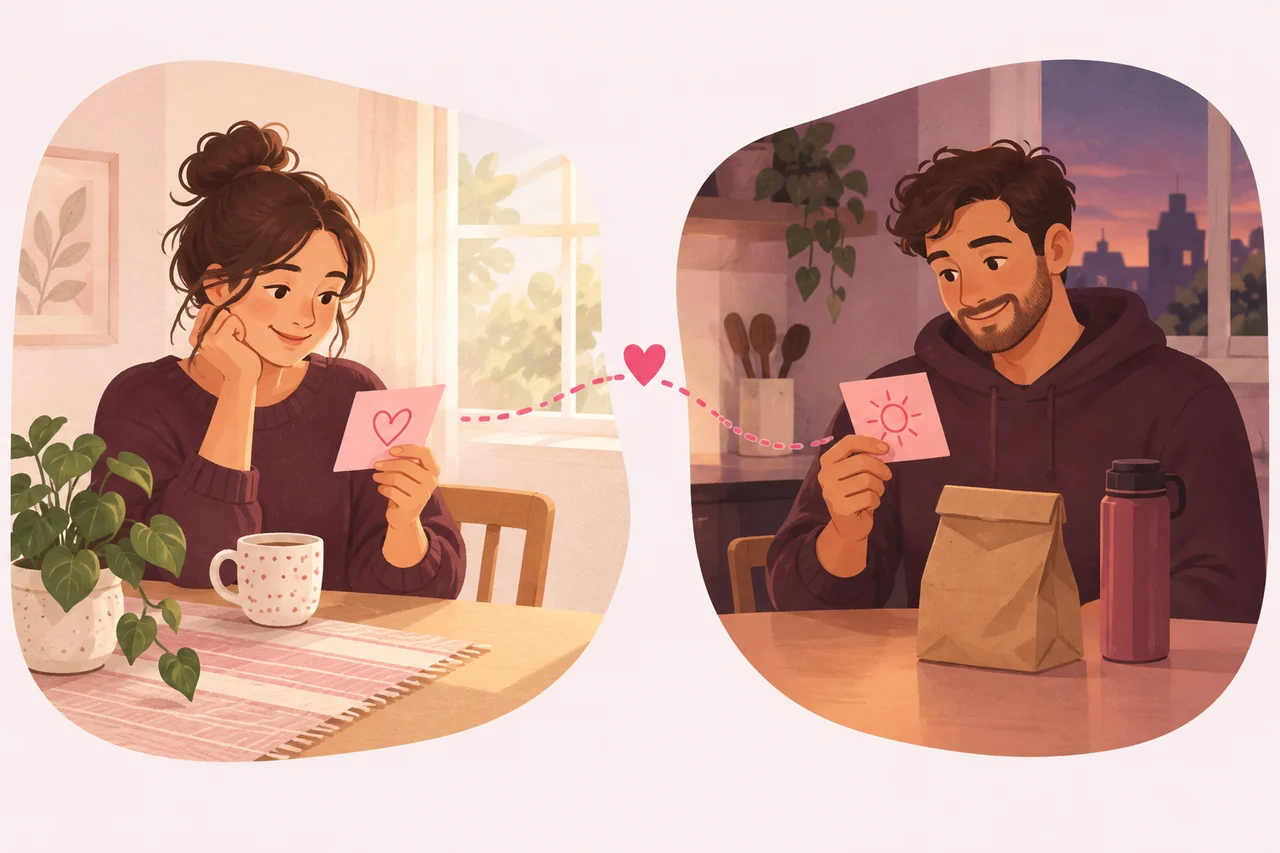
When you work opposite shifts, try sharing one small piece of your day that your partner can find later. Agree that it doesn’t need an immediate reply, each contribute something ordinary, and leave the longer conversation for a time you both choose. A photo of breakfast or a sentence about your walk can be the whole exchange—not the start of another task.
You don’t have to stay awake for a live catch-up to try this. Start with a note or the messaging tools you already use. If you’d like a private place for both sides of the day, PairStreak offers daily photo, video or doodle moments and private chat.
What could this look like on a real working day?
Here’s a made-up example, not a customer story or an app schedule.
One partner leaves for an early shift. The other works afternoons and evenings. They agree: “Let’s each leave one little thing today. No need to answer during work or sleep.”
- Before the early shift: One leaves a picture of a slightly wonky breakfast. “The toast did not survive. Hope your morning starts better.”
- Before the later shift: The other shares a doodle of the kitchen plant. “Our only successful breakfast guest.”
- When there’s room: Either can add a small response. Neither needs to turn it into a full report or keep the conversation going while working.
With a paper note, the exchange might happen on the kitchen counter. In messages, each person can send their contribution when it suits them. In PairStreak, each can share a daily photo, video or doodle; both daily moments open after both partners have contributed.
That last detail matters: a PairStreak daily moment isn’t immediately visible to the other person before they’ve shared theirs. If you need to communicate something directly, use a channel you’ve both agreed to check rather than relying on the daily reveal.
What are we trying to share when our schedules don’t overlap?
Choose a little glimpse, not a complete summary. You might want your partner to see the odd cloud above your workplace, the mug you chose, or the lunch you finally remembered to pack.
This is different from exchanging household information. “We’re out of milk” is useful, but it doesn’t have to be the only thing you leave for each other. You can keep practical messages and small personal details separate so neither becomes hard to find.
It’s also different from starting an important conversation. A photo of your desk doesn’t need to carry an unspoken request to discuss a disagreement. If there’s something you want to talk through, ask for a time rather than disguising it as a light daily exchange.
The opposite-schedules problem has ordinary, specific versions. In a firsthand account on Babes Who Hustle, Jessica Hatch describes working daytime hours while her partner works as a bartender at night. She writes about personal texts, things to see when there’s a free minute, and notes left around their apartment. That’s one person’s experience, not proof that a particular routine works for every couple.
Our suggestion here is smaller than a full plan for managing shift work: find one detail you’d like the other person to encounter, without requiring you both to be available at once.
How do we agree that a reply can wait?
Say it before you begin. Don’t rely on both people silently understanding what a new habit means.
You could try: “I’d like us to share something small from our separate days. Would that feel nice? I don’t want either of us waiting for an instant reply.”
Then talk about what each of you wants. Perhaps one likes sending a photo before leaving home; the other prefers a quick drawing after breakfast. Those choices don’t need to match. Neither person has to copy the other’s format or amount of writing.
Make the invitation easy to decline. If your partner doesn’t want another daily activity, accept that rather than offering a succession of smaller versions until it becomes difficult to say no. You can try a note once without signing up for a routine.
Avoid making a response time into a measure of care. If you’re unsure what silence means, ask when you’re both available instead of turning the exchange into a guessing exercise.
What can we share when nothing interesting happened?
Ordinary is enough. You don’t need to go somewhere, make something impressive or photograph a good-looking version of your life.
Try one of these invitations:
- Something beside you: A cup, a plant, your work bag or the view from your seat.
- One small surprise: A funny sign you noticed or an unexpectedly colourful lunch.
- A tiny drawing: The weather, a sleepy kettle or your artistic interpretation of breakfast.
- Something that brought your partner to mind: A snack they like or a place you’d enjoy visiting together.
Only share what you’re comfortable sharing. A workplace photo isn’t necessary, and you can choose something from home instead. Don’t include other people or private information just to find something to send.
You don’t have to attach a question. “Here’s my little corner of today” can stand on its own. If a question would feel welcome, our conversation starters beyond ‘How was your day?’ offer light options you can both answer when you want.
How can we try this in PairStreak?
Start by agreeing on the exchange outside the app: something small from each person, with no demand for an instant response. Then use PairStreak as the private place for your daily moments.
- Each choose one moment. A daily moment can be a photo, video or doodle. The two contributions can look completely different.
- Share your own contribution. Your partner’s daily moment stays hidden until you’ve shared yours; both open once both of you have contributed.
- Return when you have room. There’s no need to arrange a live conversation around looking at the exchange. You can use private chat to talk about what you shared.
- Keep the invitation small. This article’s opposite-shift example is an activity to try, not a built-in shift planner or a promise of scheduled messages.
PairStreak describes moments as daily. Its website doesn’t specify the posting window or how daily boundaries apply to different time zones, so don’t assume an overnight shift follows a particular cutoff. Use the app’s current guidance for timing; if a daily format doesn’t fit your hours, your exchange can stay in notes or ordinary messages.
The useful distinction is that both people bring something. It isn’t one partner assembling an update for the other, or one person becoming responsible for reminders. You can each offer a different view of the same ordinary day.
What if one of us is asleep when the other wants to talk?
Leave the small exchange for later and discuss longer conversations separately. This activity doesn’t require either person to interrupt sleep, check a phone during work or wait up to see a reaction.
When you do have some time together, you can decide whether you want a catch-up, quiet company or something playful. A little shared detail is a possible starting point, not a requirement to discuss every message you sent.
If you’d rather do something than talk, our low-energy activities for couples include a silly doodle and an ordinary-object hunt. You can borrow one when it appeals, without turning your limited shared time into a schedule of activities.
For something time-sensitive, agree on another way to reach each other. A delayed daily exchange shouldn’t be your only plan for information that genuinely needs attention.
What if we miss the exchange or it starts feeling like work?
Begin with today rather than assigning yourselves a backlog. You don’t need to recreate three lunches or explain every quiet day before sharing something new.
Ask which part feels cumbersome. Is it choosing a picture? Thinking of words? Feeling watched for a reply? The answer might be a simpler contribution, a different format or not doing the activity right now. It doesn’t have to be a better reminder system.
Keep the activity separate from keeping a streak. A missed exchange isn’t a test you need to pass, and one partner doesn’t need to manage the other’s participation. If you no longer both want it, pause.
If you enjoy keeping little details, PairStreak’s shared memories let you return to earlier moments. Our shared memory journal guide has more ideas for a record you both contribute to—but you don’t need to start a journal to leave one note today.
Your opposite-shift sharing questions
Do we have to be awake at the same time?
Not for the note or message exchange suggested here. Each person can contribute separately. PairStreak’s daily reveal opens after both partners share, rather than requiring a live call.
Should every photo get a reply?
Decide together what feels welcome. The suggestion here is a small exchange without an immediate-response obligation, not a new rule that every contribution needs commentary.
Can we try this if we live together?
Yes. A note on the table can be a starting point. Living in the same home doesn’t mean your free hours overlap, and the activity doesn’t need an app.
Is PairStreak a shift calendar or scheduled-message tool?
We’re not describing those features. Its role here is daily photo, video or doodle moments, a reveal after both contribute, private chat and shared memories.
Leave one little piece of today
Ask your partner whether they’d like to try one small exchange: something from each of you, found when there’s room, with no rush to reply. Start with the tools you already have and let an ordinary detail be enough.
If you’d like a private space for both sides of your day, try PairStreak with your partner. Each bring a photo, video or doodle, see your daily moments after both have contributed, and continue the conversation when it suits you both.