To play a one-sentence story game with your partner over text, start with one made-up sentence, then take turns adding one sentence each. Choose something ordinary—a mug, a sock, a slightly suspicious sandwich—and let it become a tiny fictional adventure. Stop after a few turns, or whenever either of you has had enough. There’s no score, no right ending and no need to reply immediately.
This is for the moments when you’d like to be playful together without planning a whole game night or finding another question to ask. Use messages you already have. If you’d like a private space for the exchange, you can also try it in PairStreak’s private chat. The activity below is our suggestion, not a built-in game we’re promising inside the app.
What does a complete round look like?
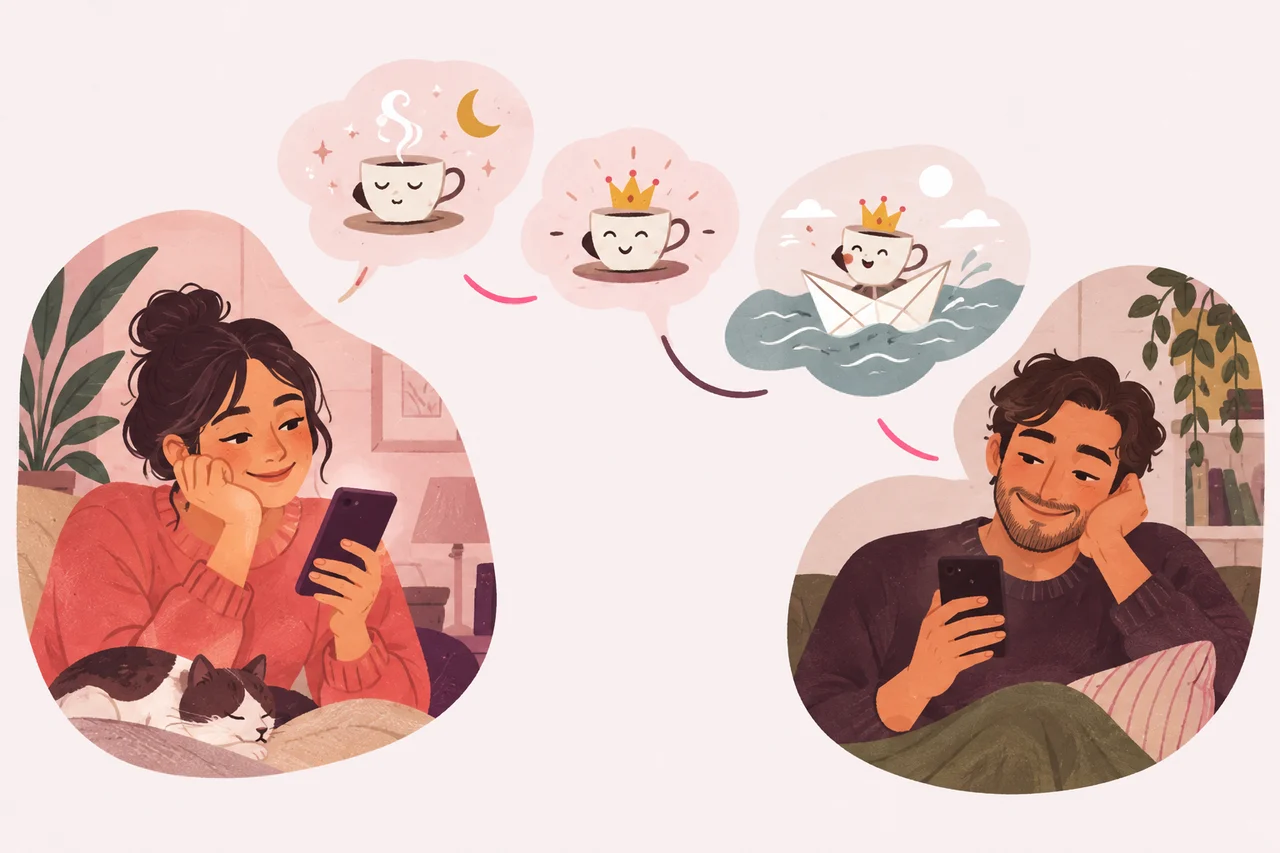
Here’s a made-up exchange you can borrow. These are fictional lines, not a customer conversation.
You: The kitchen mug had decided it was taking the day off.
Your partner: It put on a tiny crown so nobody would ask it to make tea.
You: Unfortunately, the teaspoon arrived with a very important invitation.
Your partner: The royal breakfast needed someone to captain a paper boat.
You: The mug agreed, provided the sea was made of hot chocolate.
Your partner: And that is why breakfast was postponed until Tuesday.
That’s a whole little story: three sentences from each person, one ridiculous problem, and an ending that doesn’t need explaining. You can leave it there. Neither partner has to top the other’s joke or suggest a sequel.
You don’t need to be funny in the same way, either. One person might add a strange detail; the other might give it a very sensible consequence. “The mug went home” is allowed. The invitation is to make something together, not audition as a writer.
How do we start without making it complicated?
Ask first: “Fancy making up a tiny story, one sentence each?” If your partner wants to, agree on a small stopping point. Six sentences between you is one option, not a rule you need to finish.
Then try this:
- Choose an ordinary subject. An object beside you is enough. You don’t need to search for the perfect idea.
- Give it something to do. A cushion wants a holiday. A sandwich has missed its bus. A houseplant receives a mysterious letter.
- Send one sentence. Leave room for your partner to decide what happens next.
- Take turns. Add to the detail you’ve just received rather than replacing the story with your own plan.
- End when you want. Give your characters a small landing place, or simply say, “Shall we leave our plant there?”
Keep the first attempt small. There’s no need for a timer, a shared document or a list of rules. If one of you writes two sentences by accident, nothing has gone wrong. The one-sentence format is there to make starting easy, not to give you something to police.
What can our first sentence be?
Pick one that makes you curious, change a word, or use an object you can see. These starters are editorial ideas you can use anywhere, not a list of prompts included in PairStreak.
- The last biscuit in the tin had a secret.
- Our houseplant was expecting a very small visitor.
- The umbrella refused to go outside unless it could choose the destination.
- A paper boat arrived on the kitchen table carrying a single pea.
- The sleepy kettle had booked a seaside holiday.
- Someone had left a tiny suitcase beside the toaster.
- The sock under the sofa had finally written home.
- At midnight, the shopping list added one item of its own.
You can keep everything cosy and ordinary. A story doesn’t need danger, romance or an elaborate twist to give the other person something to add. An object wanting lunch can carry the whole adventure.
If a starter feels blank rather than inviting, make the next step concrete: where is the character going, what are they carrying, or who has just arrived? Choose one detail, not a full backstory. Your partner gets to bring some of the surprises.
What if we can’t think of anything clever?
Add the most obvious next thing. If the plant receives a letter, it can open it. If the sandwich misses a bus, it can sit on a bench. Not every sentence needs to be the funny one.
You could also offer two directions: “Does the tiny suitcase contain a hat or an emergency biscuit?” Let your partner choose, then continue. That’s an optional way to get unstuck, not a test with a correct answer.
Leave room for different styles. One person may write short, practical sentences while the other enjoys extravagant descriptions. You can both take part without matching word counts or trying to sound like each other.
And if inventing things feels like work tonight, stop. Our low-energy activities for couples include a silly doodle, a song each and an ordinary-object hunt. Or do nothing extra. You don’t have to rescue an activity just because you started it.
Can we play when we’re not online together?
Yes. Leave a sentence for your partner to find when they have room, then let the next turn wait. Before you start, make the pace clear: “No rush with this—I just thought our kettle deserved an adventure.”
There’s no need to keep checking whether the other person has continued. A pause in a fictional story is just a pause. You can return later, decide you’ve lost the thread, or let the characters remain exactly where you left them.
If you’re juggling different work hours, our guide to sharing your day on opposite shifts offers a separate, ordinary-moment exchange. That guide is about glimpses of your actual days; this game is about making something up. You can choose whichever sounds better, without committing to both.
Keep practical or time-sensitive messages separate from the story so they aren’t mistaken for part of the game. A playful exchange shouldn’t become the only way you communicate something that needs attention.
How could we try this with PairStreak?
PairStreak is a private space for two partners, with daily moments, private chat, couple games and shared memories. Its private chat lets you text and send additional photos, videos or doodles. That gives you somewhere to write your alternating sentences without making the activity a public performance.
Start with the invitation, then send your opening line in chat. Your partner adds the next line when they want to. We’re not describing a special story editor, automatic turn-taking or a dedicated storytelling mode; these are ordinary messages you write yourselves.
You can also begin with a small visual idea. Each share a photo or doodle as your daily moment, then choose something from the revealed pair to inspire your fictional character. PairStreak’s daily moments stay hidden until both partners have contributed; both open after you’ve each shared. Don’t expect a daily photo to appear to your partner before that mutual reveal.
For example, one person could share a mug and the other a doodle of a boat. Once both moments open, you might decide the mug is going sailing. The story itself can continue in private chat. Taking pictures is optional: you can skip the visual step and start with a sentence.
PairStreak also has couple games, but this particular sentence-by-sentence activity is an idea from this article. Try it with the tools you already use before deciding whether you want a new place for your daily exchanges.
How do we keep it playful rather than personal?
Use invented characters and low-stakes problems. A biscuit looking for a hat leaves room for silliness without asking either person to reveal something they don’t want to discuss.
Don’t turn a character into a disguised criticism of your partner. If you want to talk about chores, a missed message or something that hurt, ask for a real conversation at a time you both agree to. The sleepy kettle doesn’t need to carry an argument.
Let each other skip a direction that isn’t enjoyable. You can say, “Can we keep this one cheerful?” or “Let’s not use people we know.” Then choose another detail without demanding an explanation.
If you’d rather learn about each other than invent characters, our questions beyond ‘How was your day?’ offer a different starting point. A fictional game and a personal conversation don’t have to do the same job.
Your one-sentence story questions
Do we have to be good at writing?
No. A plain sentence is enough. Describe one thing happening and let your partner add the next thing. There’s nothing to grade.
How long should we keep going?
Choose a small stopping point together, such as a few turns each, and stop earlier if either of you wants. An unfinished story is fine.
Can we play in person instead?
Yes. Say your sentences aloud while sitting together. You don’t need a phone, and you don’t need to write the story down.
Is this a built-in PairStreak game?
No built-in version is being described here. It’s an activity you can try through ordinary messages, including PairStreak’s private chat. The app’s couple games are a separate option.
Do we need to play every day?
No. Try it when you both want to. A silly story can belong to one evening without becoming a routine.
Give one ordinary object a tiny adventure
Ask your partner whether they fancy making up a story. Choose a mug, a sock or something else nearby, send one sentence, and leave space for their version of what happens next.
If you’d like a private place for your everyday exchanges, try PairStreak with your partner. Share daily photos, videos or doodles, reveal your moments after both contribute, and continue in private chat. No perfect story required—just a little room for both of you.